
Environmental Management
Mount Isa Airport seeks to operate and develop the airport in an environmentally responsible and sustainable manner.
This approach is underpinned by the Environment Policy which guides activities at Mount Isa Airport. Click here to read the Mount Isa Airport Environment Policy.
.jpg)
Environmental Context
Mount Isa Airport is situated in the arid north-western region of Queensland. The climate is characterised by hot summers and mild winters, with a pronounced dry season throughout most of the year and a wet season that typically runs from October to April.
The underlying geology is dominated by Proterozoic metamorphic rock, overlaid by late tertiary to quaternary colluvium. The lithology of this colluvium is described as consisting predominately of gravel but also clay, silt, sand and ironstone.
Drainage from the airport flows into the Leichhardt River approximately 500m east of the Airport and Spear Creek directly north (<50 m).
Mount Isa Airport is located in the Mount Isa Lnlier bioregion with the predominant vegetation being low open woodland over spinifex hummock grassland.
Portions of undeveloped areas within the airport contain state mapped ecological values including essential habitat, regulated vegetation and low potential groundwater dependent ecosystems.
Climate
 Mount Isa Airport participates in the Airports Council International (ACI) Airport Carbon Accreditation (ACA) program and is accredited to Level 4 until 30 June 2028. This means that we are committed to reducing our Scope 1 and Scope 2 emissions in line with our target emissions trajectory and to working with our stakeholders to drive reductions in Scope 3 emissions. We measure our Scope 1, 2 and 3 carbon footprint each year.
View QAL's overall organisational commitment to Net Zero by 2030 for Scope 1 & Scope 2 market-based emissions, here.
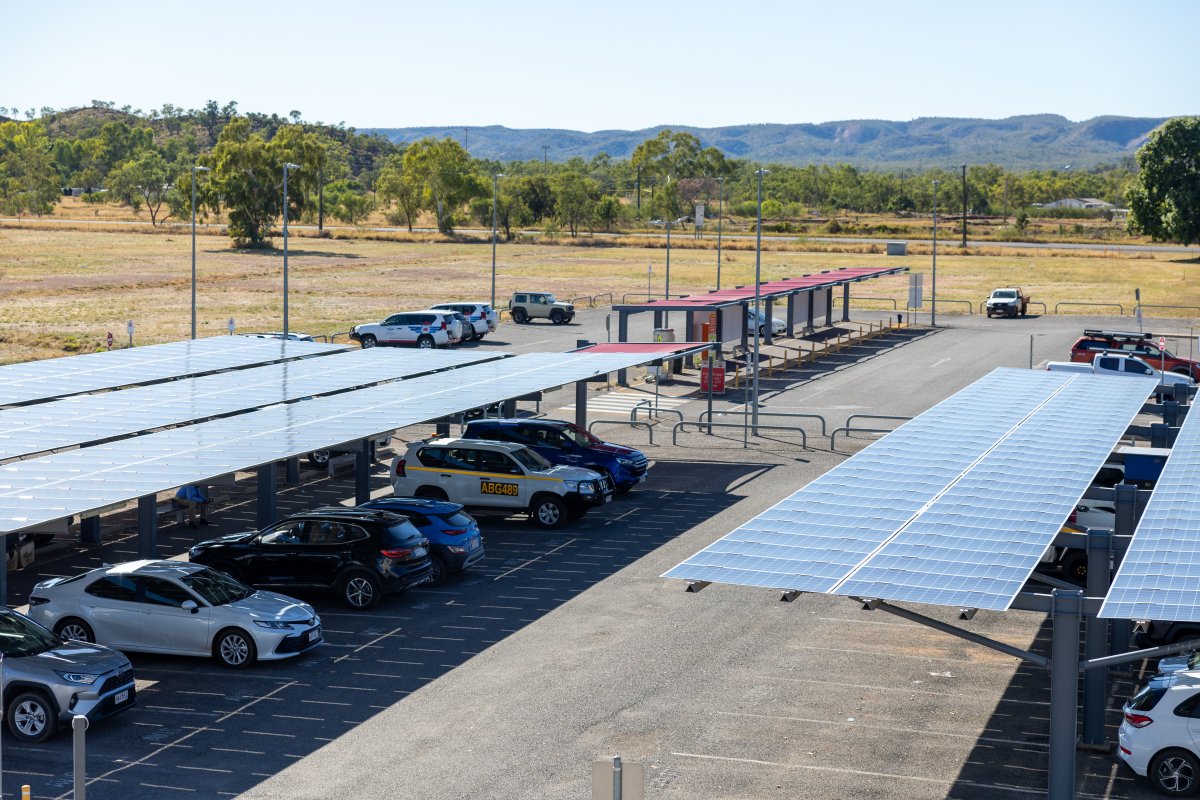
Our existing onsite solar, situated over the car park, generates around half* of our electricity needs annually. We also voluntarily surrender renewable energy LGCs for part of our electricity consumption.
Our parent company, Queensland Airports Limited is exploring how it can support the decarbonisation of aviation through the use of sustainable aviation fuel (SAF), and electric, electric hybrid and hydrogen aircraft.
For more information on QAL’s approach and commitments to ESG, please visit www.qldairports.com.au/ESG/environmental-overview
*based on our FY25 electricity consumption and activities and excluding tenant electricity
PFAS at Mount Isa Airport
We acknowledge and respect there may be community interest regarding per- and polyfluoroalkyl substances (PFAS) at Mount Isa Airport and remain committed to ongoing engagement with relevant stakeholders and management of PFAS at Mount Isa Airport.
PFAS have been detected at Mount Isa Airport. Potential sources are believed to primarily related the historic use of aqueous film forming foam containing PFAS by federal government agencies providing aviation firefighting services.
Until 1995, these aviation firefighting activities were managed by the Civil Aviation Authority (CAA). In 1995, the CAA was split into two separate government bodies (Civil Aviation Safety Authority (CASA) and Airservices Australia).
According to our current understanding, and occurring prior to our acquisition of the airport lease, Airservices Australia took control of the airport fire station and air traffic control buildings/activities from the CAA in the mid 1990s, however did not provide firefighting services. Therefore, no known use of firefighting foam containing PFAS at Mount Isa Airport has occurred since the mid 1990s.
What are PFAS?
Per- and poly-fluorinated alkyl substances (PFAS) refer to a broad group of fluorinated chemicals, including perfluorooctane sulfonate (PFOS), perfluorooctanoic acid (PFOA) and perfluorohexanesulfonic acid (PFHxS).
PFAS are manufactured chemicals used in products that resist heat, oil, stains and water.
PFAS has been used in Australia and around the world across various industries and consumer products, such as metal plating, non-stick cookware, compostable food packaging, specialised textiles, stain-resistant treatments for fabrics and furniture, and firefighting foams.
While scientific understanding of PFAS and their risks is still developing, research has shown that these chemicals are highly persistent, and some forms can bioaccumulate in humans and the environment.
What is being done about PFAS at Mount Isa Airport?
When managing PFAS on-airport we follow the PFAS National Environmental Management Plan (NEMP) current at the time of use, a national framework providing a risk-based approach to addressing PFAS contamination.
We are working with the Commonwealth Government to investigate the extent and nature of PFAS contamination at Mount Isa Airport through participation in their PFAS Investigation Program. Results of the PFAS investigation program will inform the development of a site wide PFAS Management Plan.
The Queensland state environment regulator, the Department of Environment, Tourism, Science and Innovation (DETSI), has been informed of the presence of PFAS at Mount Isa Airport and are being consulted as part of the Commonwealth Government’s PFAS Investigation Program.
For further information on the PFAS Investigation Program please click here.
Helpful links
Below are further useful links providing information on PFAS:
- https://www.health.gov.au/topics/environmental-health/about/environmental-toxins-and-contaminants/pfas
- https://www.qld.gov.au/environment/management/environmental/pfas
- PFAS National Environmental Management Plan 3.0 - DCCEEW
- Health based guidance values for per- and poly-fluoroalkyl substances
- Intergovernmental agreement on a national framework for responding to PFAS contamination
- enHealth fact sheet on Per- and polyfluoroalkyl substances (PFAS)